

Articles
2026 Grand Prize Draw – Tickets Now Available
Help us raise much needed funds for our project and buy tickets for our 2026 Grand Prize Draw.
Prizes are as follows:
* Three cash prizes of £250, £150 and £100 respectively
* Footplate ride on the North Norfolk Railway
* Miniature Replica B17 Footballer Nameplate
Tickets which cost £1 each can be bought at most of the events we attend (for a list of events see Events Calendar in the News+ tab).
Terms and Conditions of the Draw
Promotor: Richard Taylor
Date of Draw: Saturday 14 November 2026
Each winner will be contacted initially by telephone or at the email or other address shown on the winning ticket stub within 7 days of the draw and receive written confirmation thereafter.
The result will be announced via the Trust website: www.b17steamloco.co.uk within 7 days of the draw taking place.
Minimum age of participants: 16 years
The Draw is registered under the Gambling Act 2005 with Central Bedfordshire Council. Licence no. 1446
🏆 2025 Grand Prize Draw Results
The winners of the 2025 Grand Prize Draw, held at Quorn and Woodhouse station (Great Central Railway) on Saturday 15th November are:
- 1st Prize (£250): Peter Cooper, London (Ticket no. 3963)
- 2nd Prize (£150): Graham Percival, Leicestershire (Ticket no. 6134)
- 3rd Prize (£100): Anna Hallas, Cambs (Ticket no. 0513)
- Footplate Ride: Sam Brewerton, Norfolk (Ticket no. 6393)
- Nameplate: Kathryn Broughton, Cambs (Ticket no. 0694)
Congratulations to the winners and grateful thanks to all those who bought tickets!
Each and every gift made to The B17 Steam Locomotive Trust is greatly appreciated and will help us to continue developing the locomotive and carry out construction activities that would otherwise be difficult to achieve. The prime source of funding is based upon an ever increasing number of contributors making affordable gifts/donations on a regular basis and includes free membership for the duration of the payments. By choosing to become a Member, and making a regular donation by Standing Order, you will enable us to forward plan. These regular donations mean a consistent, predictable income, so we can budget and be more efficient. It is also a great way in which you can spread your donations over a period of time.
In return for becoming a member you will be entitled to certain benefits. This includes a free quarterly newsletter and attendance the two public meetings a year. One of these public meetings is the AGM and as a member you will have voting rights.
As a registered charity The B17 Steam Locomotive Trust can claim income tax relief on donations from UK tax payers, meaning that your donation could go even further at no additional cost to you. For every £1 a UK taxpayer donates, 25p in reclaimed tax can be added. Therefore a gift of £10 is worth £12.50 to the Trust when an eligible donor says "yes" to gift aid.

If you would like to support the B17 Trust by making a single or regular donations please use the donate button or alternatively please complete and return the B17 Trust donation and membership form.
Thank you for your support.
Gifts and Legacies
Writing a Will is one of the most important decisions you will make and we appreciate that it is very personal. However, should you wish to leave a legacy to the B17 Steam Locomotive Trust, please be assured that any gift, irrespective of size, is vitally important to the Trust and it will be used wisely to ensure the long term future of the project. This is our commitment to you.
As the B17 Steam Locomotive Trust is a registered charity, legacy gifts and donations will also be free of inheritance tax.
What sort of legacy could I leave?
A residual Legacy is a percentage of all what remains after your expenses and other legacies have been paid. A residual legacy is the best way to benefit the Trust because it is unlikely to be affected by inflation. Using this method, you can be sure that your gift is always within your means, whatever your financial situation in later life. Alternatively, you may wish to consider a pecuniary legacy - a gift of a specific sum of money - or a specific legacy, such as a house, share value, railway artefacts, books or photographs.
You may wish to relate any of these to funding a specific component or task. However, choosing to make an unrestricted gift will enable the Trust to direct funding to areas of greatest need, which will change as the project progresses.
Income sources generated by donations and legacies are vitally important to our future financial well- being. These will permit us to continue with locomotive development and construction activities that would otherwise be difficult to achieve.
In Memoriam
Making a donation to the B17 Steam Locomotive Trust in memory of someone special is a wonderful way to ensure that their memory lives on, whilst supporting interests that were important to them. At your request, the Trust can set up a ‘Living Memory Fund’ in your loved one’s name, which friends and family can make contributions to. A great comfort at a time of loss, a living memory fund celebrates a life, whilst helping to ensure the future of the project.
Donations
A gift of whatever size makes a difference. If you are eligible to “GIFT AID” your donation enables the Trust to claim back your contribution of income tax already paid by you at the basic rate from HMRC.
FIND OUT MORE
We would be happy to talk with you to explain how your valuable support can help the objectives of the Trust. You can contact us by entering your personal contact details on the form below and sending them to the address given or telephone the Trust (Brian Hall) on 07527 670436 and we will contact you.
Whether you wish to become a regular subscriber or make a donation please see the relevant forms below, print off and fill in manually and follow the included instructitions.
For details on how to become a regular contributor and to print off form please click here to download the B17 Standing Order and Donation form.
The 'Sandringham' class had a tortuous beginning. In 1927 new locomotives were urgently needed on the GE section, but the development of a new design was hampered by the need to keep to a low axle weight. The bridges on the Great Eastern Section had been very lightly constructed and a severe axle-load limit was in operation. Further, the small turntables limited locomotive length. Until 1928 the largest locomotives per mitted were the Holden B12 4-6-0s, which had an adhesion weight of 44 tons.
Gresley was faced with a difficult situation on the Great Eastern Section. A 2-6-4T was being developed for the Southend services, but work ceased on this partly due to the Sevenoaks accident and partly through the need for mainline motive power.
Because of the delay, the Chief General Manager requested the LNER Board for permission to order twenty B12s. Not surprisingly, this was refused, and only ten were authorised. Robert Stephenson submitted the lowest tender at £5943 per locomotive, but Beyer Peacock was successful at £5975 as faster delivery was promised. However, after the order had been placed on Beyer, Peacock, Gresley decided that the locomotives should be provided with Lentz poppet valves.
Meanwhile, negotiations were taking place with North British Locomotive Co for the development of a three-cylnder 4-6-0 costing £7280 each with a maximum axle load of 18 tons per axle in which the use of three cylinders permitted the adhesion weight to be raised to 54 tons. The nominal tractive effort of the new design was 25,280 lbf, which represented an increase of 3,411 lbf compared with the earlier 4-6-0s. The first batch was built by the North British Locomotive Co. and H.A.V. Bulleid (Master builders of steam p. 61) has stated that this Company undertook the detailed design work. See also Thompson B2 class.
In the meantime, because of Doncaster's lack of progress on the new 4-6-0 design, Lord Faringdon, the LNER Deputy Chairman, took the matter direct to Sir Hugh Reid, Chairman of the North British Locomotive Company, which had recently built the 50 LMS 'Royal Scots'. NBL solved the latter by disregarding Gresley's insistence on single axle drive, and, by moving the inside cylinder forward to drive on to the leading axle, weight was transferred to the bogie, so reducing the weight on the coupled wheels.
NBL was aggrieved that further orders went to Darlington, and there was a further major confrontation with Beyer Peacock concerning the B12 order which had been modified to incorporate Lentz valve gear. At that time, Beyer Peacock was run by Sir Sam Fay and R.H. Whitelegg, and legal action was nearly taken against the LNER
Relationships between the two suppliers ultimately improved and led to orders for J39s from Beyer Peacock in 1936 and NBL for K3s delivered in 1935. The Lentz B12s were unsuccessful and had to be rebuilt with piston valves. Bridge restrictions on the GE Section were gradually eased.
After delivery had been completed, Beyer, Peacock and the LNER were in dispute over the price. An acrimonious letter from Sir Sam Fay (then the Chairman of Beyer, Peacock) to Nigel Gresley led to an additional payment by the LNER of £1,500, to keep the matter out of the courts.
But whatever may have been said originally, future B17s were built by Darlington (for whom Armstrong Whitworth provided some of the boilers) and Robert Stephenson, but none by NBL.
Further references
Checkley, Sid. Fitter at the end of WW2 and thereafter Memories of Colwick. in Hughes, Geoffrey. A Gresley anthology. Didcot: Wild Swan/Gresley Society, 1994. pp. 77-82.
The B17 class suffered from loose seats and loose cabs. It was difficult for the fitters to reach the piston glands for the inside cylinder. On the other hand there was less on the 2 to 1 arm as it was behind the cylinders, but maintaining the regulator valve of No. 1647 was difficult. He obtained a ride on 1648 Arsenal, and this was very rough, but also very fast.
Hoole, K. North Road Locomotive Works, Darlington, 1863-1966. 1967 "These three-cylinder engines [B17] were a six-coupled version of the "Shire" class but considering the fact that the design was prepared in two different drawing offices the similarity is remarkable".
Proud, P. The Sandringhams. Rly Obsr, 1960, 30, 304. RCTS. Locomotives of the LNER. Part 2B. Tender engines—classes B1 to B19. 1975. Considers most aspects of the class including its difficult genesis and its origins at the North British Locomotive Co. Notes that consideration was given to building further locomotives of the type for the North Eastern Area (but more powerful K3 supplied instead) and for the Scottish Area (V2 class built instead). J. Instn Loco. Engrs,
[CLASS B17 4-6-0, L.N.E.R.] . 1929, 19, 2-5. illus., diagr. (s. & f. els.)
Engineer, 1929, 148 L.and N.E. Rly. passenger locomotive., 8-9. illus., diagr., plan.
N.E.R. Rly Mag., 1929, 64, NEW 4-6-0 locomotive, 98-100. illus.
L.N.E.R.. Loco. Rly Carr. Wagon Rev., 1929, 35, THREE-CYLINDER 4-6-0 express locomotive, 4-5. illus., diagr. (s. el.)
Rly Mag., 1945, 91, 113-14. Gresley locomotive characteristics. Unpopularity of the types which lacked trailing axles.
Swinger, Peter. The power of the B17s and B2s. OPC
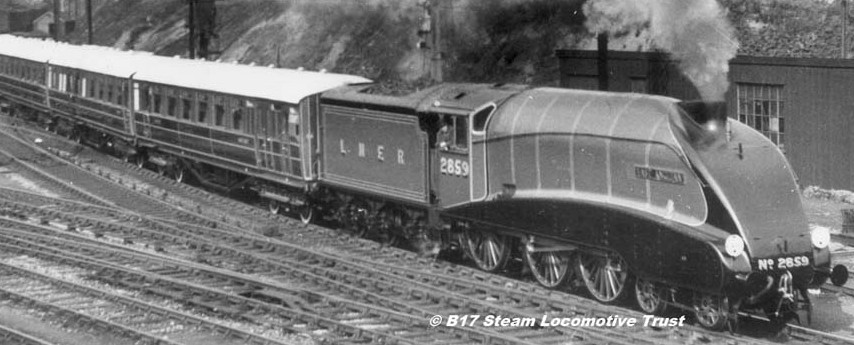
White, Malcolm. The Yarmouth train. 2005. Many of the class are illustrated mainly on services to Yarmouth South Town (some are based on colour photographs). B17/5 streamlined No. 61670 City of London is shown on the East Suffolk line on p. 3 and as de-streamlined and classified B17/6 on p.87 entering Ipswich station with a down express and the similar No. 61659 East Anglian (in colour) on p.99 approaching St. Olaves swing bridge and on p. 100 near same location.
The Sandringham class locomotive is an easily recognisable design, boasting distinguishing features that uniquely identify it within the LNER family. To understand its identity, we must look at how the B17 design evolved through aesthetic influences and internal engineering requirements.
The Design Requirement
By the mid-1920s, power requirements for the former Great Eastern Railway (GER) district were critical. Express passenger services had reached weights of up to 430 tons, creating a shortage of suitable motive power. Due to strict loading gauge limitations, locomotives from other LNER regions could not simply be transferred in.
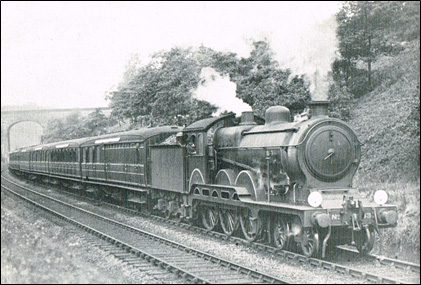
Introduced: 1911 | Designer: S.D. Holden
Boiler: 180 psi | 2 Inside Cylinders
Driving Wheels: 6ft 6in
Following the General Strike of 1926, poor coal quality led to failing performances on the Cambridge and Southend lines. LNER management ordered Sir Nigel Gresley to produce a new 4-6-0 design to supplement the B12s for heavy passenger work.
The Specification
The initial brief called for a three-cylinder 4-6-0, borrowing the motion arrangement and 6’ 8” driving wheels from the D49 class, with a tractive effort of roughly 25,000lb and an axle load limit of 17 tons. After the Doncaster design office struggled to meet these constraints, the contract was handed to the North British Locomotive Co. (NBL) in December 1927.

Introduced: 1927 | Designer: H.N. Gresley
Boiler: 180 psi | 3 Cylinders
Driving Wheels: 6ft 8in
Borrowing from the "Family"
The final B17 design was an exercise in successful "parentage," utilizing proven features from across the LNER locomotive family to expedite production:
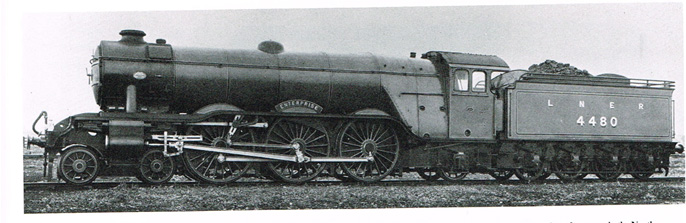
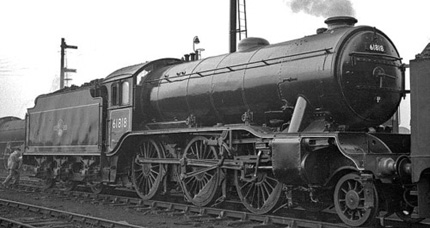
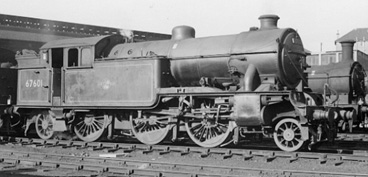
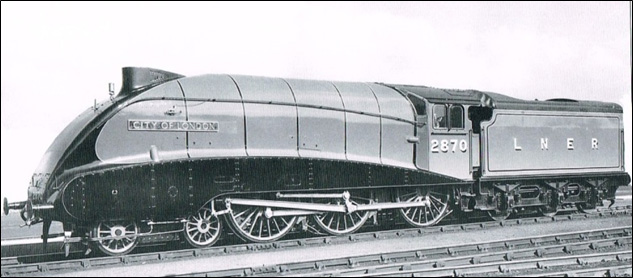
Additionally, Darlington Works provided bogie drawings, while Stratford Works designed the specific GE-type 3,700-gallon tenders required for the region's short turntables.
The "Invisible" Peculiarity
The most unique internal feature was the divided drive. Because it was physically impossible for all three cylinders to drive the middle coupled axle, the middle cylinder was positioned forward above the front bogie to power the leading axle.
Summary: B17 Parentage
Aesthetically, the B17 is the perfect montage of LNER engineering. It inherited the best features of its parental designs, proving that commonality of parts could result in a magnificent and efficient machine.
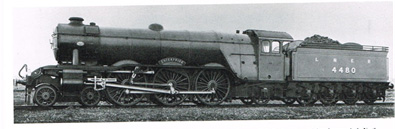
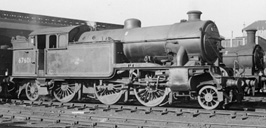
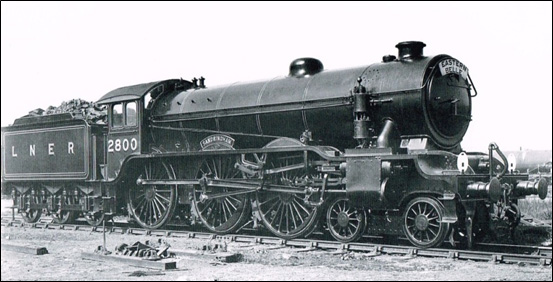
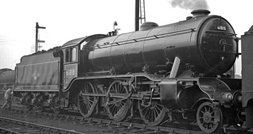
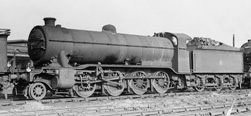
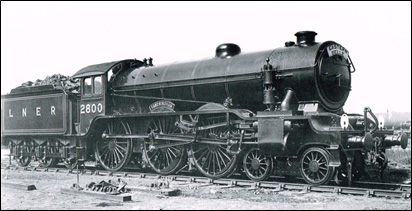
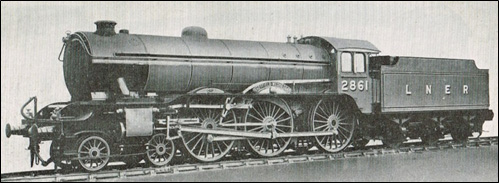
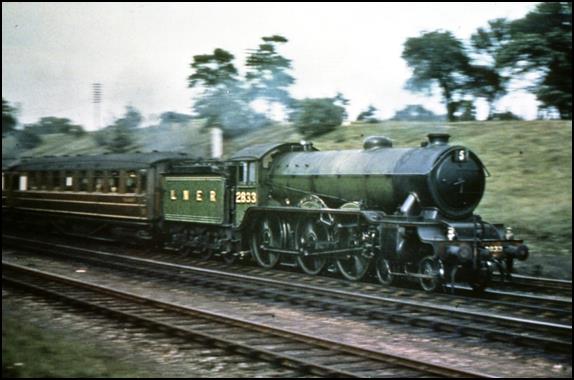
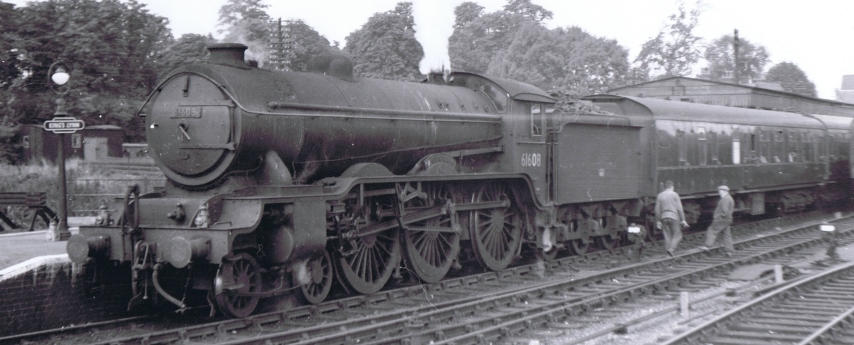
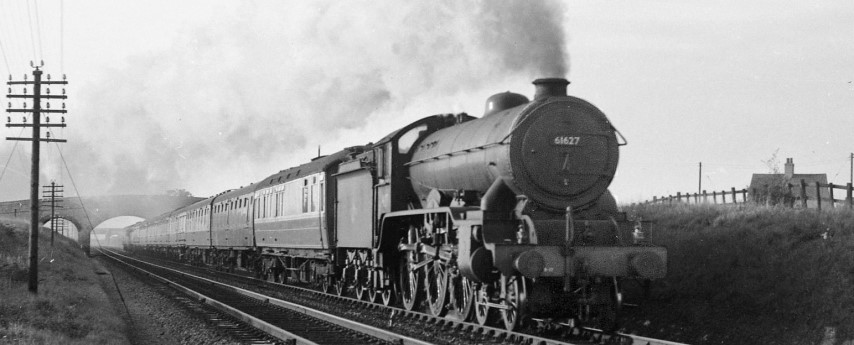
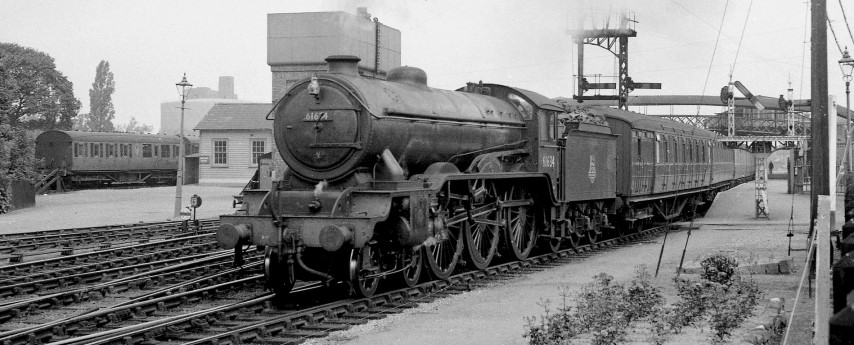
SANDRINGHAMS
...73 gleaming green beauties...
Once ruled the rails of East Anglia and from Marylebone through the East Midlands to Sheffield, climbing over Woodhead—the roof of England—to Manchester.
Holidaymakers going to Gt. Yarmouth with buckets and spades,
A Cambridge student worrying about their performance in the scholarship exam,
The businessman going up to town or further afield,
North Country travellers making their way to and from the continent via Parkeston Quay,
A ‘Sandringham’ would take them there and back again.
They were part of our landscape.
For the connoisseur, there was magic in the large, curvaceous 6'8" driving wheels, totally visible beneath small splashers and offset by the elegantly curved running plate.
Names crafted in shining brass evoked a bygone England—yet still with us.
The fabric of the nation: from the monarch's Sandringham and Royal Sovereign through City of London to our heritage of stately homes, glorious regiments, and the working man faithfully following his football club—be it mighty Arsenal or lowly Darlington.
No longer gone forever!
Now with The B17 Steam Locomotive Trust
The gleaming green finish of these locomotives with 6 ft 8 ins diameter driving wheels provided a magnificent spectacle when either stationary, awaiting the ‘right-away’ signal, or hurtling through town and country at speed with a fully laden train.
Their elegant lines with shining brass nameplates left an everlasting memory with railway staff, enthusiasts, and the general public alike who travelled on those trains or saw them pass by. However, with the rapid demise of steam, all were withdrawn from service before the preservation movement had become established; consequently, none were preserved.
Fulfilling the project aim to construct a new B17 will recreate again those exhilarating sights and sounds of a ‘Sandringham’ hard at work on the mainline at the head of its train and re-introduce something of our past heritage, for greater public benefit in years to come.